

This analysis examines the mediation initiatives and cease-fire proposals for the 2023 Gaza war, identifying and discussing recurring patterns. These include mutual mistrust, disputes over phased implementation, and a fundamental disagreement over post-war governance. These structural barriers consistently undermine negotiations, leading to a cycle of temporary ceasefires and renewed escalation, and call into question the effectiveness of traditional mediation models.

The ongoing Gaza war has been defined by periods of severe violence followed by intense diplomatic efforts for securing a ceasefire. The central and recurring theme that has been observed during most negotiations for a ceasefire is the demand for guarantees. Specifically, Hamas always demanded ‘real guarantees’ that the ceasefire would be permanent, and that Israel would not resume hostilities. A very recent example of this theme occurred during on October the 7th 2025 when Hamas demanded “a permanent, comprehensive ceasefire, a complete pullout of Israeli forces and the immediate start of a comprehensive reconstruction process under the supervision of a Palestinian “national technocratic body”. Historically, the second-biggest historical predicament during the negotiations is the theoretical question of who will permanently govern Gaza? A question that has remained unanswered since the Oslo Accords. The 20-point plan proposed an international board that would oversee the Gaza Strip, which would include Palestinian technocrats. This vague statement might consist a friction point as it requires the disarmament of Hamas, while Israel would most likely veto the involvement of the Palestinian Authority.[1] Lastly, caution is required regarding phased implementation dilemma, as progress delay from the international community and the Israeli side is credited as one of the main reasons for the failure of the Oslo Accords.
The most significant mediation initiatives and ceasefire proposals for the 2023 Gaza war were the three-phase plan and Trump’s 20-point plan. The three-phase plan was proposed by Egypt, Qatar and the United States: The first phase would begin with a ceasefire, Israel’s withdrawal from populated areas, the surge of humanitarian aid and the exchange of prisoners; The second phase proposed – upon agreement of the parties – a permanent end to hostilities in exchange for the release of all other hostages remaining in Gaza, and a full withdrawal of Israeli forces from Gaza; The third and final step regarded the start of a major multi-year reconstruction plan for Gaza and the return of the remains of any deceased hostages still in Gaza to their families.[2] Nonetheless, only the first phase was carried out. On January 15, 2025 and via US mediation, Hamas and Israel agreed on the three-phase plan, leading to the release of 90 Palestinian prisoners and 3 Israeli civilian hostages a few days later.[3] However, negotiations for the second phase stalled as Israel demanded the immediate release of all hostages while Hamas insisted on negotiating a permanent ceasefire and full Israeli withdrawal first, creating an impasse. Simultaneously, Prime Minister Benjamin Netanyahu was facing intense pressure from far-right coalition partners, threatening with the coalition’s end if the Gaza war did not resume.[4] Nevertheless, on March 18, 2025, Israel carried out extensive airstrikes, ending the ceasefire and banning the entry of humanitarian aid via all land crossings.[5].
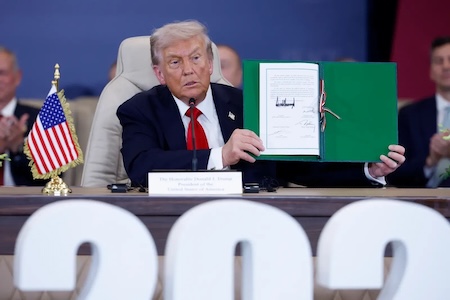
On September 29, 2025, Trump unveiled a 20-point plan outlining a process beginning with an immediate ceasefire and hostage release, followed by longer-term goals for Gaza’s governance and security. The plan aimed at a deradicalized terror-free zone that would not pose a threat to its neighbours. In a separate point, it stipulated that the territory would be “redeveloped for the benefit of the people of Gaza, who have suffered more than enough”.[6] Potential major challenges that might hinder negotiations could be the refusal of Hamas to disarm and its future role within the Palestinian Movement the extent of Israeli withdrawal and domestic Israeli politics.[7]
Three prevalent patterns may be identified in the mediation initiatives for the Gaza war. First, the demand for guarantees maintained a vicious cycle of mistrust impeding the negotiations’ progress, considering that Hamas’ central demands consisted of “real guarantees” that the ceasefire would be permanent, and that Israeli forces would withdraw before agreeing to any disarmament and hostage release. Moreover, Israel seemed reluctant to commit to a permanent ceasefire before its security demands were met. This created an impasse as neither side seemed willing to take the first step. Second, phased implementation remains a point of dispute. Since negotiations link hostage release with Israeli military forces withdrawal, Hamas’ desire for a swift process, clashes with Israel’s demand for a slow one which is considered key for maintaining strategic leverage until all demands are met. Third, the disagreements on the day after place a burden on talks with regard to ending the war. Specifically, Israel and the United States refuse to allow Hamas to maintain power, while the latter refuses to disarm and give up control of Gaza without a sovereign political horizon. This situation may create a power vacuum as the prospect of an alternative technocratic Palestinian Authority is not considered viable.
To better understand negotiation dynamics, the mediators must be examined. The United States, which traditionally have been the most powerful external mediator and closest ally to Israel, are facing intense domestic pressure while Israel’s standard defense mechanisms failing. At the same time, Qatar has become a negotiation hub as it maintains good relations with antagonizing states – such as the United States and Iran – and is considered one of the most important mediators in the region and home to the political office of Hamas. The latter provided a base for negotiations between Israel and Hamas.[8] As an immediate neighbour, Egypt brings historical weight to the process, having been a key mediator in previous conflicts. Its role is heavily influenced by direct national security interests, particularly the stability of its border with Gaza.[9] Turkey’s involvement is shaped by its growing political influence in the region and its distinct relationship with Hamas. While supporting the US-backed 20-point plan, its stance is often framed within a broader strategy of challenging what it perceives as US hegemony and containing Iranian influence, positioning itself as an independent power center in the negotiations.[10]
Following the ratification of the 20-point plan, the first steps have been successfully completed from both sides, with the gradual release of the hostages. But the ceasefire still remains fragile as Israel has limited new aid entering Gaza and attacks remain an occurrence.[11] Additionally, more tensions arise as Israel has accused Hamas that the remains recently handed over did not belong to any of the hostages.
The Gaza ceasefire negotiations reveal a vicious cycle: the patterns of deep mistrust, the issue of postwar governance, and the dilemma of phased implementation continuously sabotage the mediation efforts. These structural obstructions are more significant than any proposal or the identity of the mediator, ordaining negotiations to a cycle of temporary truces and certain escalation. This recurring failure compels a critical examination of the mediation model itself: Can traditional mediation overcome these patterns? Other approaches, such as internally driven diplomacy, which promotes informal dialogue between civil society leaders, academics, and mid-level officials from both sides, or more inclusive regional frameworks that sincerely incorporate a wide spectrum of Palestinian political voices, may be essential.[12] Such models aim not to immediately finalize a treaty, but to slowly rebuild the foundational trust and generate creative, bottom-up solutions that high-level talks consistently miss.
All links accessed on 2/11/2025.
[1] Nidal al-Mughrabi and Maayan Lubell, “Hamas says on war anniversary it’s ready to reach Gaza deal, but conditions remain,” Reuters, October 5, 2025, https://www.reuters.com/world/middle-east/israeli-forces-shell-gaza-war-anniversary-hamas-israel-discuss-trump-plan-2025-10-07/; Scott Lucas, “Israel and Hamas agree ceasefire deal – what we know so far: expert Q&A,” The Conversation, October 9, 2025, https://theconversation.com/israel-and-hamas-agree-ceasefire-deal-what-we-know-so-far-expert-qanda-267113.
[2] United Nations, “UN Security Council proposed a 3-phase ceasefire deal to end war in Gaza – Adopted resolution [S/RES/2735 (2024)] at its 9650th meeting,” June 10, 2024, https://www.un.org/unispal/document/sres2735-2024-10jun24/.
[3] Al Jazeera, The path to the Israel-Hamas ceasefire deal in Gaza,” January 19, 2025, https://www.aljazeera.com/features/2025/1/19/timeline-the-path-to-the-israel-hamas-ceasefire-deal-in-gaza.
[4] Britannica, “Israel-Hamas War – Ceasefire and hostage exchange (January–March 2025),” October 10, 2025, https://www.britannica.com/event/Israel-Hamas-War/Ceasefire-and-hostage-exchange-January-March-2025.
[5] Raffi Berg, “Gaza ceasefire deal – the latest on the truce,” BBC, March 18, 2025, https://www.bbc.com/news/articles/cy5klgv5zv0o; Eyad E. Baba, “Gaza: No aid has reached war-torn enclave for more than three weeks,” UN News, March 26, 2025, https://news.un.org/en/story/2025/03/1161531.
[6] Robert Tait, “What’s in Trump’s 20-point peace plan for Gaza?” The Guardian, September 19, 2025, https://www.theguardian.com/world/2025/sep/29/trump-peace-plan-gaza-israel-hamas.; Tom Bennett, “What we know about the ‘first phase’ Gaza ceasefire deal,” BBC, October 14, 2025, https://www.bbc.com/news/articles/cvgqx7ygq41o.
[7] Nadeen Ebrahim, “Trump announced his 20-point Gaza peace plan. What comes next?” CNN September 30, 2025, https://edition.cnn.com/2025/09/30/middleeast/trump-gaza-plan-what-comes-next-intl; Daniel W. Drezner, “Americans Are Changing Their Views of Israel. That’s a Problem,” Politico, August 16, 2025, https://www.politico.com/news/magazine/2025/08/16/israel-criticism-americans-gaza-shift-00506649.
[8] Al Jazeera, “Why does Qatar host Hamas’s political office?”, September 9, 2025,https://www.aljazeera.com/news/2025/9/9/why-does-qatar-host-hamass-political-office.
[9] Caterina Roggero and Eleonora Ardemagni, “A 20-Point Plan, But What Peace for Gaza?” ISPI, October 9, 2025, https://www.ispionline.it/en/publication/a-20-point-plan-but-what-peace-for-gaza-218496.
[10] BBC News,“Gazze görev gücünde Türk askeri olacakmı?” October 9, 2025, https://www.bbc.com/turkce/articles/cpd9wqyp3wgo.
[11] Shurafa Wafaa and Josh Boak, “Israeli strikes in Gaza kill at least 104 people, hospitals say,” AP News, October 30, 2025, https://apnews.com/article/israel-palestinians-west-bank-hamas-gaza-445eea84db9c19600b9ab92786b7fb7c; Josef Federmann and Samy Magdy, “Israel resumes ceasefire in Gaza and says aid deliveries will restart Monday,” AP News, October 20, 2025, https://apnews.com/article/israel-palestinians-hamas-war-news-10-19-2025-f3d95cf76018541ff824853d1bcd3356.; Renata Brito, “Israel says the latest remains returned from Gaza are not bodies of hostages,” Associated Press, November 1, 2025, https://apnews.com/article/israel-hostages-ceasefire-gaza-bodies-hamas-9f6e7a4e64548b683d33cab88614b840.
[12] Fatma M. Göçek, “Historicizing the Gaza War Through the Use of Collective Violence,” Georgetown Journal of International Affairs, October 3, 2025, https://gjia.georgetown.edu/2024/10/03/historicizing-the-gaza-war-through-the-use-of-collective-violence/.

