

 Once more Sudan is stricken by protest. Sudanese are on the streets due to the increase of bread prices. The government responded violently towards the dissent. Five people lost their lives, around 60 have been arrested including the leader of the Sudanese Communist Party Mokhtar al- Khatib, and the regime blocked the sale of several newspapers.
Economic reasons solely are behind the demonstrations. The prices of basic needs and commodities such as bread, medicine, electricity and fuel have increased in unprecedented levels. The government eliminated wheat subsidies from its 2018 budget. It’s adopting austerity measures in line with IMF recommendations, and inflation rose to 25 % making extremely difficult for ordinary Sudanese to buy imported goods. The country is also lacking hard currency to facilitate needed imports. The measures aim to make Sudanese economy more competitive since it can no longer depend on its oil resources since 2011 when South Sudanese separated, after a half century of war with Sudan. The longest Africa has ever seen.

In October 2017 Sudanese society welcomed the lifting of US sanctions in the country. The US first imposed sanctions on Sudan in 1997 due to human rights violations and terrorism concerns. In 2006 it increased the severity of its sanctions due to the massacres taking place in Darfur. Lifting of the US sanctions come after UAE and Saudi Arabia pressed US in favour of Sudan. Sudan has reportedly provided 1000 ground troops to fight on the side of the Saudi coalition in Yemen. On the other hand, Sudan got in return Saudi promises for future investment[1].
The economy is collapsing and 75% of the budget goes for the needs of the military, security apparatus and militias affiliated with the regime. No serious amount is invested or healthcare, education or job creation although the youth suffer unemployed. The only response is that government is printing more money[2].
President Omar Bashir who rules the country the last 30 years, is wanted by the International Criminal Court on charges against humanity and war crimes for his Darfur atrocities back in 2003. He is the first head of state ever indicted by ICC. Human rights and prodemocracy activists fear he will try to run for the 2020 elections, a move that goes against the US brokered agreement that ended the war with South Sudan and gave its independence. They are afraid that the government will become even more violent against civilians due to the lifting of the embargo. Sudan still suffers from war in two regions. Darfur and South Kordofan although are more like skirmishes than a real war, the last year.
The current protest has been organized by the Communist Party mainly for the economic problems, ordinary Sudanese face daily. The epicentre of the protest is the University of Khartoom where students claim that the regime has kidnapped protestors. The crackdown has been relatively calm for the standards of the region and we need to remember that in similar protest 5 years ago in Sudan 185 people lost their lives while protesting against fuel prices spikes. As I claimed few years back, we should not expect a regime change in Sudan or something tremendous to come out of these protests[3]. A big part of the conservative Sudanese society acknowledges Omar al–Bashir as one of their own. He is successful in presenting the opposition as agents of external enemies, whatever that means. The opposition is not united and no one has called for violent riots with the target to have regime change. Radical youth voices coming from the university sadly once more will be ignored.
More interesting is to examine where Sudan stands in the chess currently played in the Horn of Africa.
Foreign relations
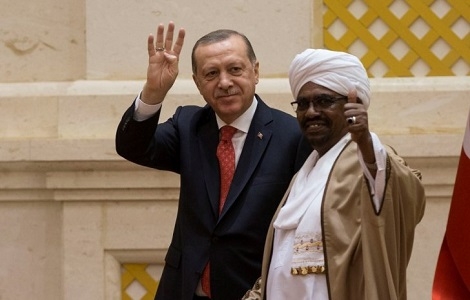
Several interesting developments occurred for Sudan when it comes to its standing in the world. Recep Tayyip Erdoğan visited Sudan in December 2017. The two countries agreed to boost trade. Turkey will rebuild a ruined Ottoman port city in Sudan’s Red Sea and construct a naval dock. The agreement comes months after Turkey built a military base in Somalia, its largest outside Turkey. Analysts focusing in the area have already notices the growing influence of Turks in the region.[4] Furthermore, Turkish investors will build Khartoom’s new airport and invest heavily in cotton production, electricity generation, and they will build grain silos and meat slaughterhouses [5].
Egypt did not see the Erdogan’s visit positively. Egypt still remembers fearfully Sudan’s support for the Muslim Brotherhood in Egypt few years ago. Bashir himself came to power in a military coup in 1989; he allied himself with Hassan al-Turabi, the leader of a Sudanese offshoot of the Muslim Brotherhood. About a decade later, the two fell out and al-Turabi was subsequently imprisoned.
Secondly the two countries find themselves on different sides on another important issue as well. The Ethiopian Renaissance dam the biggest when finalised in Africa, will bring irrigation and electricity benefits in Sudan, but Egypt believes will see its hold over Nile water diminished. Furthermore, the Hala’ib Triangle border region dispute strains further the relationship of the two countries. Egypt recently sent hundreds of its troops to a UAE base in Eritrea, on the border with Sudan[6]. Sudan shut its border with Eritrea and deployed thousands of troops there.
Analysts claim that the Gulf Crisis is played out in the Horn of Africa. “Ethiopia, just like Sudan, has become closer to Qatar in its struggle to navigate the ongoing tensions in the Gulf. The Ethiopian government, which previously accused Egypt of supporting separatist movements on Ethiopian territory, understandably chose to place itself against Egypt in this conflict. Meanwhile, Eritrea, which is in the midst of a long-standing conflict with Ethiopia, has taken the side of Saudi Arabia, Egypt and UAE, the latter having a military base on Eritrean territory”[7].
In November 2017 Sudan’s President visited for the first time Russia and met President Putin, Prime Minister Medvedev and Defence Minister Sergey Shoygu. Russia not only ignored the ICC warrant against Omar al–Bashir but also sent a Russian plane to Khartoom to ensure his safety. On the other hand, Omar al Bashir expressed support for Russia’s Middle Eastern policies. A gesture that will not be taken lightly in Riyadh and Washington.
Commentators vary on how they approach his trips and cosy up with Russia. Some think the whole trip and rapprochement with Russia took place because Sudanese president found out that the US will not back him up for 2020 Sudanese elections. So, he went to Russia in order to be able to have an international ally and backer, so he can stay in power. Maybe he believes he would be better off with Russia and Iran since they are winning in other middle eastern fronts. Or he is just disappointed with Saudi and Emiratis regarding their investment promises in his country. The fact that Russia managed to keep Assad in place also plays a role. On the other hand, his trip to Russia is seen by other as blackmail to Washington and Riyadh so he can manage to achieve better treatment.
All these should be examined in light of a growing tension in the area. Ethiopia suffers from violent protest the last two years. This month Ethiopian Prime Minister quit and still we don’t know his successor.
The deployment of Egyptian troops to Eritrea has sent longtime for Ethiopia into a frenzy. Aware of the poor relations between Egypt and Ethiopia over Nile water use, Eritrea eagerly welcomed the Egyptian troops. On the other hand, Ethiopia which has the third-largest army on the continent, responded by sending more troops to the border with Eritrea. Asmara and Addis Ababa have had two bloody wars over border disputes.
Ethiopia is also uneasy that the United Arab Emirates, which is close Cairo, has been stepping up its presence in the region. It recently acquired military and naval bases in countries that have borders with Ethiopia, Somalia to the east and Eritrea to the north, as well as Yemen. This has led Ethiopia to steam ahead with construction of the dam, saying that more than 60 percent has already been completed [8].
To conclude Sudan current protests are not unusual or extremely worrying for the country. Compare with what is happening in Ethiopia, Egypt and South Sudan where bloody war is ravaging the already destroyed country, Sudan seems stable with quite good prospects ahead. The country has improved its relations with the US. The US lifted its embargo, negotiations are still taking place for further improvement of relations. Turkey will invest in the country and Russia will sell arms and its support to al- Bashir. Sudan will exploit the Gulf Crisis to its benefit by keeping a good relationship with Qatar while holding an excellent relationship with the Saudis and who they support in Yemen. Bashir will ease tensions domestically by paying the key people, exactly as he did in 2011. A social revolution and democratic Sudan will remain a fantasy for the years to come.
* Menelaos Agaloglou was Protection Delegate of the International Committee of the Red Cross (ICRC) in Kachin State in Northern Myanmar and in Kasai State in the Democratic Republic of Congo (2016-2018). Previously he was the Head of Geography and Economics Department in the International Division of the Greek Community School in Addis Ababa (2011-2015).
[1] Amin, Mohammed, “‘Back to square one’: After US sanctions lift, Sudan doubles down on repression,” Middle East Eye, (27/12/2017)
[2] Adam, Ahmed, H. “Without meaningful change Sudan will descend into chaos,” Al-Jazeera, (14/02/2018)
https://www.aljazeera.com/indepth/opinion/meaningful-change-sudan-descent-chaos-180214090216308.html
[3] Agaloglou, Menelaos, “Why Sudan’s Arab spring is a fantasy”, The Africa Report, (26/09/2012) http://www.theafricareport.com/Columns/why-sudans-arab-spring-is-a-fantasy.html
[4] Kucukgocmen, Ali, Abdelaziz Khalid, “Turkey to restore Sudanese Red Sea port and build naval dock”, Reuters, (26/12/2017)
https://www.reuters.com/article/us-turkey-sudan-port/turkey-to-restore-sudanese-red-sea-port-and-build-naval-dock-idUSKBN1EK0ZC
[5] ibid
[6] Al-Jazeera, “Why are tensions rising in the Red Sea region?”, (16/01/2018) https://www.aljazeera.com/news/2018/01/tensions-rising-red-sea-region-180109064758337.html
[7] Adam, Ahmed, H., “What is going on between Egypt and Sudan?”, Al-Jazeera, (12/01/2018)
https://www.aljazeera.com/indepth/opinion/egypt-sudan-crisis-180110134022602.html
[8] Al-Jazeera, op.cit.

